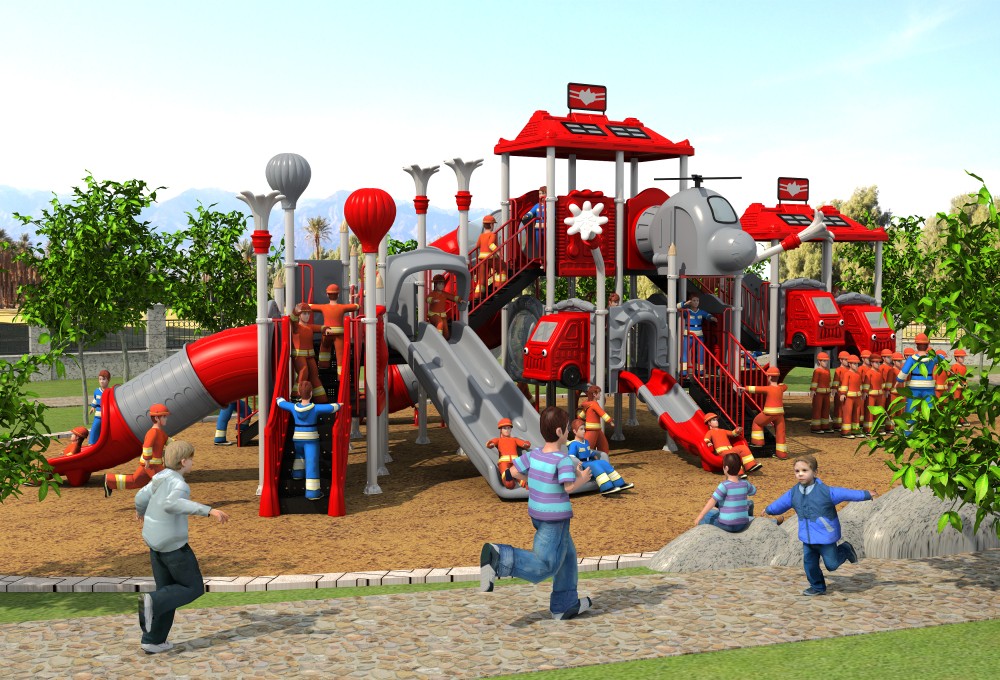
Global slide design is evolving towards a direction that integrates nature, promotes creative interaction, and is inclusive for all ages. Among them, the "unpowered park" in Japan and the "natural playground" in Northern Europe have become two representative models. The former stimulates curiosity through recycled materials and cultural narratives, while the latter emphasizes the harmonious coexistence of wooden structures and ecological landscapes, jointly providing a transferable design paradigm for modern children's play spaces.
I. Japan's Inactive Amusement Park: A Creative Playground Transforming Waste into Treasure
In a limited urban space, Japan has created highly imaginative playgrounds without the use of power, emphasizing the recycling of materials and the integration of cultural connotations.
The magical world constructed by tires: Nishi Rokugo Amusement Park
The Nishi Rokugo amusement park located in Tokyo (also known as the "Tire Amusement Park") is almost entirely constructed using recycled rubber tires. Facilities such as the Godzilla-shaped slide, jungle gym, and swings are all made from discarded tires from the Kawasaki manufacturing plant. Thousands of tires can also be freely stacked, rolled, and jumped on by children, allowing for open-ended play. This low-cost, highly interactive design is not only environmentally friendly but also greatly stimulates children's creativity and hands-on skills.
Cultural narrative integrated into game tasks: Historical relic-themed slide in the Central Plains region
Some amusement parks have transformed local cultural heritage into game elements. For instance, the "Hirata Ladder" and "Six Villages Waterbed Bed" slide attractions are all named after historical sites, and are accompanied by "task cards" to guide parents and children to complete the challenge together. This approach not only enhances the fun of the visit but also achieves cultural enlightenment education.
Bionic structures inspire imagination: Takino Hillside Park and Parque Gulliver
In Takino Hillside Park in Sapporo, slides are combined with sandy areas to simulate the climbing paths within the folds of human hands and feet. In Parque Gulliver in Valencia, Spain, based on "Gulliver's Travels", a giant human-shaped slide was created. Children can crawl through "hair" and "clothing" to enter and exit the slide, immersing themselves in a fairy tale scene.
II. Nordic Nature Playland: A Return to the Authentic Ecological Play Space
The Nordic countries advocate the concept of "nature as the classroom". The playgrounds there mostly incorporate elements such as logs, rope nets, and terrain undulations, emphasizing symbiosis with the environment.
Wooden structure blending with the forest: Suoyao wooden Nordic-style playground
The slide and climbing tower, built from logs, blend seamlessly with the surrounding forest. Combined with green rubber flooring and natural stone paving, this design visually aligns more closely with nature. Such a design reduces the sense of artificial intervention, allowing children to develop an awareness of the ecological environment during play.
Multifunctional Composite Slide Set: Case Study from Chen Dong Sports Coastal Park
Combining the climbing net, stainless steel speed slide and double-rope challenge track, the "Courage Hill" system is formed. The slide is not only a descent passage but also a hub connecting different functional areas, promoting the comprehensive development of children's coordination, balance and courage.
Family Integration and Lifelong Participation: Design of Indoor Curved Slide
In Nordic family homes, there are also common designs of small slides. For example, toys are hidden behind sliding doors, and curved slides are set up to connect the upper and lower floors, which not only saves space but also enhances parent-child interaction. This concept of "home as a playground" extends the usage scenarios of the slides.
III. Design Insights: Transferable Creative Methodology and Safety Standards
Dimension Japanese Model
Material selection: Recycled tires, metal components
Design concept: Cultural regeneration, high-density composite facilities
Interaction method: Open stacking, task checking-in
Safety Policy: Soft flooring, adult supervision area
Applicable scenarios: Urban parks, community micro-renewal
Dimension Nordic Model
Material selection: Raw wood, ropes, natural stone
Design concept: Natural integration, low-intervention ecological design
Interaction method: Exploratory climbing, sensory immersion
Security Policy: Structural Stability Test, Anti-slip Treatment
Applicable scenarios: Suburban parks, ecological communities
Although the two models have different approaches, they both emphasize the "child-led game rights" - that is, allowing children to independently decide how to play in an unstructured and non-electronic environment, thereby developing creativity, risk assessment skills and social abilities.
 浙公网安备33032402002684号