Foreword
In modern early childhood education, outdoor playground equipment is far more than just "toys for entertainment"—it serves as a mobile classroom that nurtures children’s comprehensive development. As the centerpiece of kindergarten outdoor spaces, a well-designed slide can seamlessly integrate physical exercise, cognitive development, social interaction, and aesthetic education into children’s daily play.
This guide is tailored for kindergarten principals, playground designers, and procurement professionals. It aims to help you create a safe, engaging, and educationally rich outdoor slide that transforms ordinary amusement facilities into growth-promoting spaces for children aged 3–6 (with extended adaptability for 3–12 years old). By the end of this guide, you’ll understand how to balance fun and learning, ensuring every slide becomes a catalyst for children’s holistic development.
1. Core Design Principles for Educational Kindergarten Slides
Before integrating educational elements, all designs must adhere to 4 non-negotiable principles to ensure they meet kindergarten-specific needs:
Safety First & Compliance: Strictly follow international safety standards (EN 1176 / ASTM F1148) with rounded edges, non-slip surfaces, stable galvanized steel frames, and food-grade PE materials. Avoid sharp corners or narrow gaps that pose risks to young children.
Age-Appropriate Customization: For 3–6-year-olds (kindergarten core group), slide height should not exceed 1.2m, slope between 30–35°, and step depth ≥15cm. For 7–12-year-olds, parameters can be moderately adjusted (max height 1.5m) without compromising safety.
Fun-Education Balance: Educational elements should be "hidden in play"—avoid rigid teaching. Design through themes, interactions, and sensory stimulation to let children learn unconsciously.
Space Efficiency: Fit kindergarten courtyards (typically 200–500㎡) with compact slide dimensions (e.g., 500×265×380cm) that accommodate 5–10 children simultaneously, leaving enough circulation space (≥1.5m around the slide).
2. 5 Key Educational Elements to Integrate into Slide Design
① Physical Development Education: Build Gross Motor Skills
Slides are ideal for developing children’s gross motor skills, which are critical for early childhood development:
Climbing Stairs: Reinforces leg strength, balance, and coordination. Design non-slip steps with textured surfaces and handrails (height 60–80cm) suitable for small hands.
Sliding Movement: Enhances body control, spatial perception, and vestibular development. A scientific slope (30–35°) ensures safe speed while providing sensory stimulation.
Multi-Level Interaction: Add low platforms (height ≤80cm) or gentle climbing nets to the slide structure, encouraging children to crawl, climb, and transition between movements—boosting muscle control and risk awareness.
Practical Tip: For small kindergarten yards, choose a compact slide (e.g., 500×265×380cm) with integrated climbing stairs and a single slide path. It supports 5–10 kids to play in turns, maximizing physical activity in limited space.
② Cognitive Enlightenment: Learn Through Visual & Tactile Cues
Use thematic design and sensory details to turn the slide into a cognitive tool:
Color Cognition: Adopt soft, bright color schemes (e.g., sky blue, grass green, warm yellow) to stimulate visual development. Avoid overly saturated colors that may cause eye fatigue. Label colors on steps (e.g., "Red Step 1") for interactive learning.
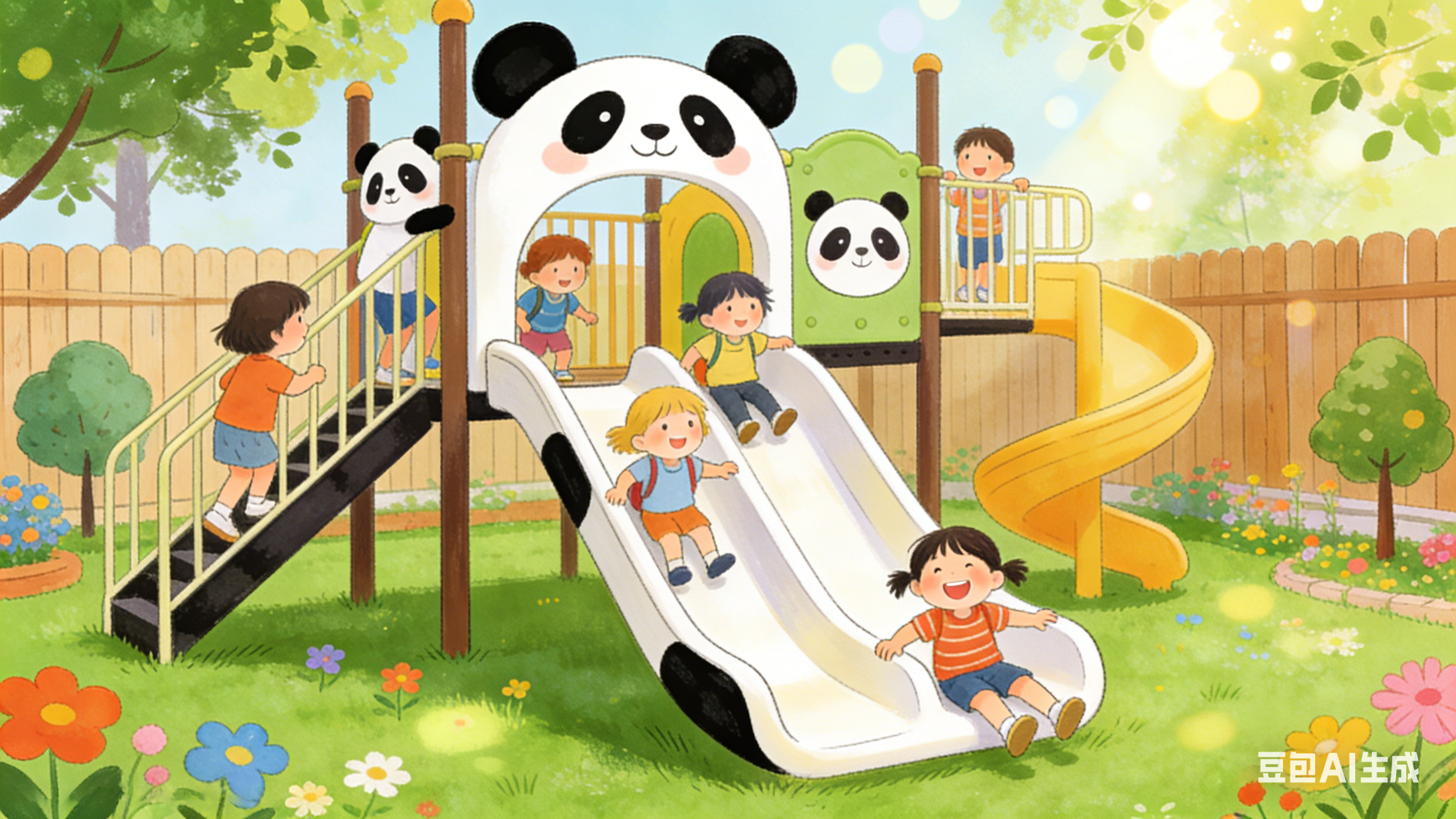
Animal/Object Recognition: Integrate child-friendly themes (e.g., panda, forest, ocean) into the slide’s appearance. For example, a panda-themed slide with ear-shaped handrails and bamboo-patterned steps helps children recognize animals and nature elements.
Shape & Number Learning: Design slide platforms or handrails in basic shapes (circles, squares, triangles) and add embossed numbers (1–10) on steps. Children can count while climbing, reinforcing numerical cognition.
③ Social & Emotional Education: Foster Interaction & Empathy
A well-designed slide encourages positive social behavior among young children:
Turn-Taking & Rules: The natural flow of "climb → wait → slide" teaches children to queue and respect others’ turns, cultivating patience and rule awareness.
Cooperative Play: Add small interactive elements (e.g., a shared platform or a gentle tunnel before the slide) to encourage communication. For example, children can help each other climb or cheer for peers sliding down, enhancing teamwork.
Emotional Regulation: Sliding provides a sense of achievement, helping children build confidence. For shy children, the supportive environment of group play reduces anxiety and promotes social integration.
④ Sensory Experience: Stimulate Multiple Senses
Engage children’s senses (sight, touch, motion) to deepen their learning experience:
Tactile Stimulation: Use different textures on surfaces—smooth PE for the slide path, textured rubber for steps, and soft foam for handrails. This helps children distinguish materials and develop tactile sensitivity.
Visual Variety: Incorporate transparent slide sections (e.g., a clear tube slide segment) or colorful LED lights (solar-powered for outdoor use) to create visual interest and stimulate curiosity.
Motion Sensation: The gentle acceleration of sliding provides vestibular stimulation, which is crucial for balance and spatial orientation. Avoid overly steep slides that may cause discomfort.
⑤ Aesthetic & Natural Education: Connect with Nature
Integrate natural elements into the slide’s design to nurture children’s appreciation for beauty and nature:
Thematic Cohesion: Choose nature-inspired themes (panda, bamboo, birds, flowers) that align with kindergarten curriculum. A panda-themed slide, for example, can be paired with surrounding plants to create a "mini forest" play area.
Material Harmony: Use eco-friendly materials (recycled PE, sustainably sourced wood) and earthy tones to blend the slide with the outdoor environment, teaching children about environmental protection.
Artistic Details: Add hand-painted murals (e.g., panda families, blooming flowers) on the slide’s side panels. These artworks not only enhance aesthetics but also inspire children’s imagination.
3. Balancing Safety & Education: Key Design Tips
Educational elements should never compromise safety—here’s how to achieve balance:
Structural Safety: Ensure the slide’s frame is made of galvanized steel (rust-proof, wind-resistant) and the slide path is thickened PE (≥10mm) to withstand frequent use. All connections must be reinforced with anti-loose screws.
Space Planning: For a 500×265×380cm slide (5–10 kids capacity), reserve a safety zone of ≥1.8m at the slide exit and ≥1m around the climbing area to prevent collisions.
Age-Appropriate Challenges: Educational elements (e.g., number labels, shape puzzles) should match children’s cognitive level. For 3–4-year-olds, focus on basic recognition; for 5–6-year-olds, add simple problem-solving (e.g., "Find the square handrail to climb").
Maintenance Accessibility: Design the slide with easy-to-clean surfaces and removable parts (e.g., puzzle panels) for regular maintenance. This ensures long-term safety and preserves educational functions.
4. Practical Case: Panda-Themed Educational Slide for Kindergartens
For small to medium-sized kindergartens (outdoor area 200–300㎡), the 500×265×380cm Panda-Themed Educational Slide is a highly recommended solution. It integrates all 5 educational elements while meeting safety and space requirements:
Specifications: 500 (L) × 265 (W) × 380 (H) cm; capacity 5–10 children (3–6 years old); materials: food-grade PE slide + galvanized steel frame + non-slip rubber steps.
Educational Highlights:
Physical Development: Climbing stairs (textured steps + low handrails) and gentle slide slope (32°) train balance and coordination.
Cognitive Learning: Panda ear-shaped handrails (shape recognition), bamboo-patterned steps with embossed numbers (1–5), and black-white color scheme (color contrast learning).
Social Interaction: Compact platform (≥1.2㎡) allows 2–3 children to wait safely, encouraging turn-taking.
Sensory Experience: Smooth PE slide path + soft foam panda "nose" decoration (tactile stimulation) + transparent slide segment (visual interest).
Aesthetic & Natural Education: Lifelike panda design + eco-friendly materials, aligning with kindergarten nature education themes.
Safety Compliance: Meets EN 1176 (EU) and ASTM F1148 (US) standards; rounded edges (radius ≥5mm); weight capacity ≥50kg per child.
5. Frequently Asked Questions (FAQ)
Q1: What size of outdoor slide is suitable for a kindergarten with 50–100 children?
A: For kindergartens with 50–100 kids, we recommend 2–3 slides to avoid overcrowding. Choose compact models (e.g., 500×265×380cm, 5–10 kids capacity each) or medium-sized slides (800×300×400cm, 8–12 kids capacity) based on your outdoor space. Ensure the total play area per child is ≥2㎡ to maintain safety and comfort.
Q2: How to ensure educational elements don’t make the slide too complex for 3–4-year-olds?
A: For young children (3–4 years old), keep educational elements simple and intuitive: focus on color recognition (bright, distinct colors), basic shapes (circles, squares), and familiar animals (pandas, rabbits). Avoid small detachable parts or complex puzzles that may cause frustration. The core goal is to make learning feel like play, not a task.
Q3: Can we customize the educational theme of the slide to match our kindergarten’s curriculum?
A: Yes! We offer full theme customization. Whether your curriculum focuses on nature, space, fairy tales, or cultural education, we can design the slide’s appearance, colors, and educational details accordingly. For example, a "space-themed" slide can include planet labels, star-shaped handrails, and number counting (1–10) for cosmic exploration learning. We also provide free 3D design renderings for confirmation.
Q4: What materials are best for outdoor educational slides in kindergartens?
A: The optimal material combination is:
Slide path: Food-grade high-density PE (non-toxic, UV-resistant, anti-aging, easy to clean).
Frame: Galvanized steel (rust-proof, durable, wind-resistant for outdoor use).
Steps/Rails: Non-slip rubber (for steps) + soft foam (for handrails, optional for 3–4-year-olds) to prevent falls and injuries.
All materials must comply with REACH (EU) and CPSIA (US) standards to ensure no harmful substances.
Q5: How to maintain the educational functions of the slide over time?
A: Regular maintenance includes:
Cleaning: Rinse the slide with water monthly to remove dust; wipe educational elements (e.g., number labels, puzzles) with a mild detergent to prevent fading.
Inspection: Check for loose screws, damaged textures, or faded educational details quarterly. Replace worn parts (e.g., non-slip steps, puzzle panels) promptly.
Protection: Apply UV-resistant coating every 2 years to extend the slide’s lifespan and preserve color vibrancy.
Q6: Is there a difference between educational slides for kindergartens (3–6 years old) and primary schools (7–12 years old)?
A: Yes! For 3–6-year-olds: Lower height (≤1.2m), gentler slope (30–35°), simpler educational elements (basic recognition), and more safety features (soft handrails, larger steps). For 7–12-year-olds: Higher height (1.2–1.5m), steeper slope (35–40°), complex educational elements (problem-solving, teamwork challenges), and modular designs (e.g., slide + climbing wall combinations). Our slides can be customized to fit both age groups.
Q7: How long does it take to produce a customized educational slide, and what is the warranty?
A: Production lead time for customized slides is 15–30 working days (depending on theme complexity). We offer a 2-year structural warranty (steel frame) and a 1-year warranty for accessories (slide path, educational panels, steps). Our after-sales team provides 24-hour technical support and on-site maintenance if needed.
Q8: Can the slide be installed indoors if the kindergarten has limited outdoor space?
A: Yes! Our compact slides (e.g., 500×265×380cm) are suitable for indoor use with proper ventilation and floor protection (e.g., rubber mats). Ensure the indoor ceiling height is ≥4m and the play area is free of obstacles. Indoor slides use the same safety and educational design but may include additional anti-noise padding on the slide exit.
Conclusion
A high-quality kindergarten outdoor slide is a harmonious blend of play, education, safety, and aesthetics. By integrating the 5 key educational elements outlined in this guide, you can turn a simple slide into a powerful tool for children’s physical, cognitive, social, and emotional development.
If you’re planning to upgrade your kindergarten’s outdoor play space, we’re here to help:
Custom educational theme design tailored to your curriculum.
Safe, compliant structures that meet international standards.
Space-efficient models (including 500×265×380cm for small yards).
One-stop service: design → production → installation → after-sales support.
Contact us today for a free design consultation and quote—let’s create an educational play space where children can learn, grow, and thrive!
 浙公网安备33032402002684号